Thursday, May 3, 2012
Post-card from Manhattan April 2012
Our yearly pilgrimage to New York was as pain-free as possible with United Airlines looking after us yet again. It was a little stressful arriving at a new building even though it is in the same area as we normally stay. The doorman was actually waiting on the footpath outside the Fitzgerald Building: “Are you Mister Byrne?” as we pulled up about 9pm. The apartment is larger and far better appointed than our old lodgings. It is also bright and sunny with an outlook down Broadway towards Columbus Circle as well as a sliver of the Hudson River down 74th Street.
The Metropolitan Museum has several special exhibits at present including a pre-dynastic Egyptian collection (my favourite period) and one of late Byzantine and early Islamic art (600 to 800AD). Both were fascinating with many objects of interest and carefully worded explanatory notes in each room.
Our musical schedule started on day three with the New York Philharmonic doing Tchaikovsky’s 5th symphony and Mozart’s 9th piano concerto at Avery Fisher Hall with Maestro Blomstedt. We had splendid front row centre seats almost underneath the piano … we feel very privileged to just drop in from nowhere and be looked after like royalty, largely because we booked so long ago I suspect.
Next we had La Traviata at the Met on Saturday night, the second outing of this opera in a month, having seen it Sydney on a pontoon on the harbour (but that is another story - see my opera blog). Unfortunately at the Met performance the soprano Natalie Dessay expired at the end of Act I rather than Act III - and was replaced by the understudy. Dmitri Hvorostovsky was the star as Papa Germont, infusing dramatic intensity with glorious vocalising. The ‘clock’ production was avant garde and eclectic. I saw another more satisfactory Met Traviata performance the following week with Ms Dessay in better voice.
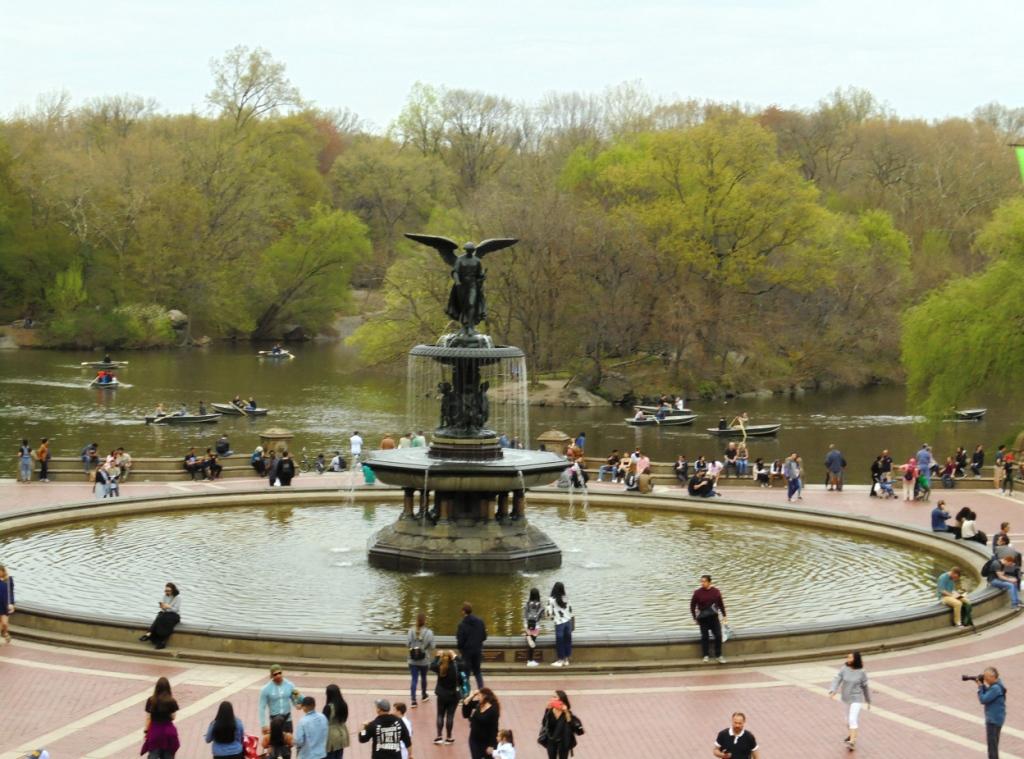
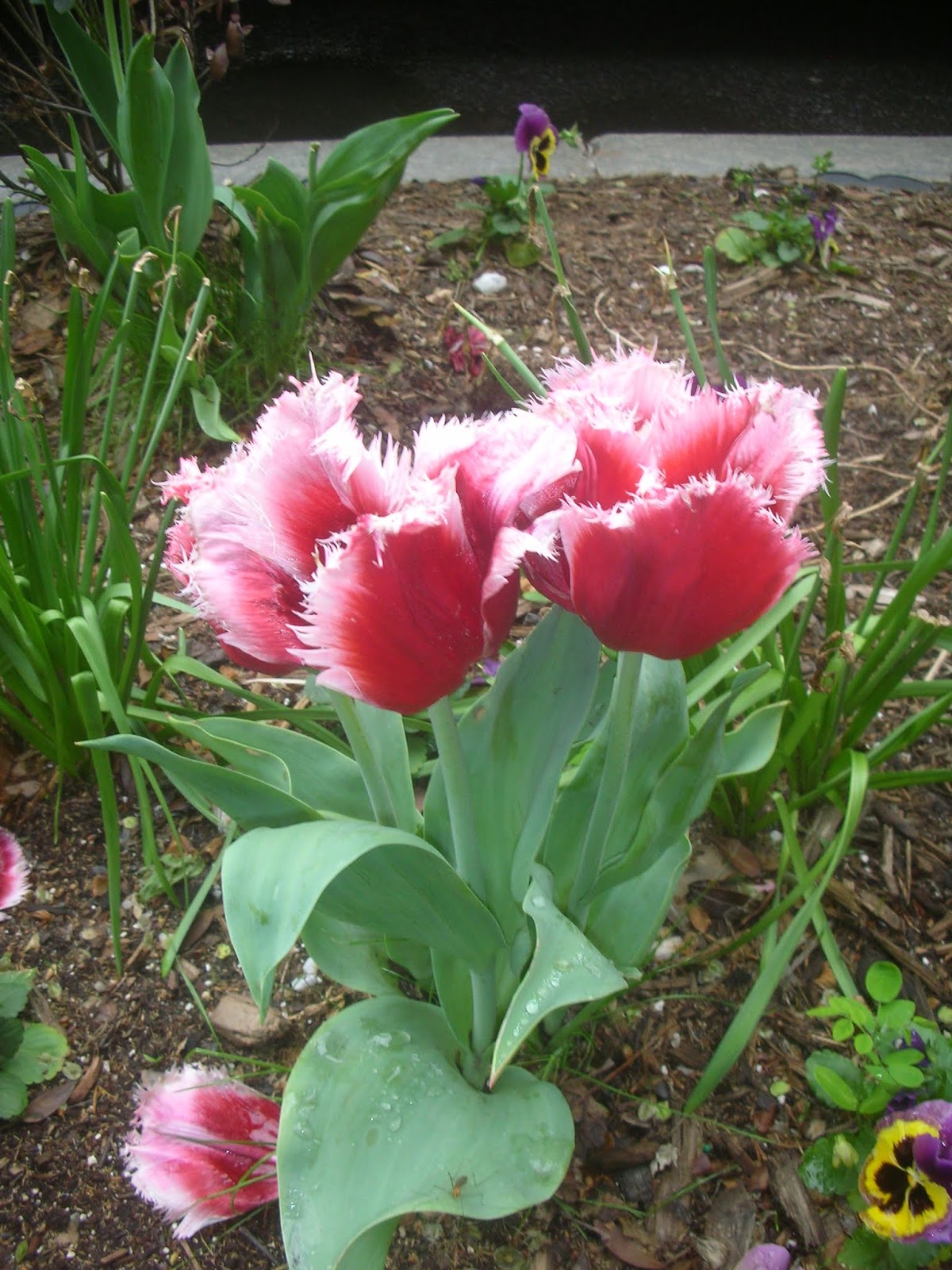
An early spring had sprung just before we got here. Cherry trees were still covered with blossoms but herbage was fast outstripping the blooms. Forsythia was finished and not a single yellow flower was to be seen around the boundaries of Central Park. Likewise the snowdrops, magnolias and daffodils were well and truly finished but tulips were in full bloom in formal gardens all over the city for our arrival in the city. A full circle of the larger variety in yellow and red ‘flame’ tulips surrounded the statue of Verdi next to 72nd Street Station.
We had a box of grog delivered from our favourite shop on lower Broadway near Astor Place. The ‘Liquor Warehouse’ has wine and spirits at prices which are less than duty-free shops and a huge range. French wine is much cheaper in New York than in Australia so we ordered three bottles of Sancerre, three of Muscadet and a bottle of Sicilian red wine for cooking. Just because we were on holiday I asked the owner for a bottle of Veuve Cliquot champagne. Ever the comic, he said: “Do Australians still drink ‘Agent Orange’?” He also had various stories about wine down the ages, whisky and even Irish whiskey, my personal favourite being Jameson green label (or the gold label which can only be obtained in America).
The Manhattan apartment is very classy compared with the previous one we stayed in. There is a large separate bedroom with a dining room and large lounge and three large windows facing south (where the sun comes from in the northern hemisphere). Despite being above Broadway, the eleventh floor is quiet and we are right across the road from Fairways the provisioner and Zabars is only a few blocks north. The owner was apparently responsible for one of the great box office disasters in Hollywood history. “Ishtar” was set on location in Morocco with Warren Beatty and Dustin Hoffman. There is history everywhere in this city!
Meeting at VA Fort Hamilton on Friday went well and I had the privilege of meeting some old Vietnam soldiers and airmen with various ailments. Beth Israel Medical Center kindly invited me to address their Leadership Meeting on Wednesday 25th and I also met with a leading expert on buprenorphine. The Thursday saw the start of the Ring operas with Rheingold, a single act lasting two and a half hours!
As we walked home after dinner one evening we just ran into a larger than life ‘Elmo’ from Sesame Street just walking down the road. He had a ridiculous red hairy suit, huge languid eyes and an orange drip nose (see photograph).
On Friday 27th April 2012 we were treated to a bird’s eye view of the original space shuttle atop a NASA jumbo jet being ferried from Washington to JFK to then be floated to a museum - yet another sign of America’s previous greatness.
More anon! Greetings to all from New York.
Monday, January 2, 2012
Galapagos space-spaniels. Spoof on 'The World Around Us'.
[To be read with a breathy, festinating, plum-in-mouth accent; tongue-in-cheek!]
This week, we examine life on an icy atoll a thousand miles from the nearest land fall.
From where I stand, over a million Galapagos space-spaniels can be seen on their annual return from Alpha Centauri, high in the southern skies. On February 14th every year with Julian precision, they complete the long migration in the intergalactic race for procreation right here on this desolate, windswept outcrop.
The males land precisely 90 minutes ahead of their mates who they recognise by not only their punctuality, but also from their individual umbilical sweat gland odour. Once paired off, they perform a captivating goose neck swan dance, first seen when the island was used by pirates in the 16th century. This ritual is the only example of coitus frigidis in the entire animal kingdom. Whenever the couples become aware of being observed they coyly abstain and flee, barren, self-conscious and inconsolate back into the cold waters of the inhospitable south seas to feed, prior to the long interplanetary trip home. Today we will attempt, for the very first time, to film these mysterious rites, both the foreplay calisthenics as well as the sex act itself on a concealed camera.
As you can hear, the couple are reaching the crescendo of their pas-de-deux. The male moves away from the female, and approaches our hidden lens. He raises his claws. There seems to be some interference in the reception. Oh dear! I fear that our camera has become an intimate part of the erotic ballet... and another casualty in the dangerous fight for survival in this remote part of the galaxy!
Courting pairs make a guanochyme nest in their first month on the atoll. They regurgitate five times their own body weight in this epoxy-like substance to produce a resilient 'igloo' structure to protect their eggs.
Invariably two male and four female pups hatch. The two smallest females are ritually sacrificed on the third day and fed to the others. This leaves the sexes equal, builds up food reserves and reduces in-breeding which is so common in these lower amphidactyls. These marvellous, blood-thirsty creatures spend the next six weeks feeding their remaining young which quadruple in weight every 24 hours. They are taught the important lessons needed for defence in deep space where they must fend off comets, asteroids, space-shuttles, lethal sun-spot radiation and other hazards. Alpha Centauri is 4 light years away, so few live long enough for a return flight.
That is it for this week's program. Next week from the universe, we turn to a microcosm. We look at life in a gold-fish bowl with a difference. With the promugulated fish-eye lens and the icthyencephalogram, we examine observations of a doctor's waiting-room from inside the fish-tank. We will learn a carp's opinion of Medicare, we interview a pair of Siamese fighting fish on euthanasia, and we look at the weather-loach's approach to contraception. Looking forward to seeing you all then. Bye for now!
Written by Andrew Byrne with apologies to 'The World Around Us' [from the 1990s archive]. Dr Byrne is a G.P. practising in Redfern, N.S.W.
Saturday, March 27, 2010
Postcard from New York (part II).
Dear Friends and Colleagues,
It has been a bizarre time in the big apple. After “snowmageddon” in February, the area has seen an early burst of spring. Then there was a weekend storm of biblical proportions: trees down, power blackouts and transport mayhem. Much of the infrastructure is dilapidated and people are just not prepared for such events. Then the sun came out again and more beautiful days followed with temperatures nudging 20 degrees Celsius. Our central heating was turned off for a few days.
Now the daffodils and crocuses are in full bloom with forsythia flowers appearing in yellow profusion across Central Park. Some early trees are also coming into leaf – the willows are first. Some single cherry trees and ornamental pears have also started flowering and it is almost a month before this happens in a normal spring.
Meantime the transportation system has announced a rationalization and budget cuts due to falling revenue. One subway line is to the eliminated (“W”) while others are having reduced services. Many bus routes are to close and there is a feeling that American society is still under enormous pressure despite news that the recession is over.
I have been to about five medical meetings in the three weeks since I arrived and the new health reforms have been mentioned by almost every speaker. Of course nobody truly knows what they will entail and the final form of the bill is still uncertain. There seem to be confident media predictions that about 28 million people will remain outside the new health scheme which is not due to be fully implemented until 2014. Some aspects will happen straight away, such as coverage of dependent up to 26 years of age. Illegal immigrants will not be covered, nor will many young people who may choose to pay a fine (or a tax) instead of taking medical insurance. Incredibly, some will be allowed an exemption on the basis of religion! Only in America!
Much of Manhattan appears to be prosperous and in renewal. There seems to be cleaning, maintenance and restoration going on in the tourist, financial and residential districts - despite roads which are in a terrible condition - pot holes galore! People generally seem to be in a good mood due to the early thaw after a long, cold winter here. Normally grumpy cab drivers and shop assistants are smiling and in high spirits. Medical colleagues have been generous and pleasant with many more offers of meetings, meals and functions than I could possibly accept.
New York remains the most remarkable city. Some of this remarkableness is simply the city’s consistency. My grandfather’s old postcards from 1924 describe many of exactly the same things as we note today (http://bpresent.com/harry/code/09n_new-york.php). Yet New York is also cutting edge for culture, style, finance and, of course, architecture.
The modern trend for young men to wear their jeans low on the hips has reached such a degree here in New York that commonly now the trousers are lower than the entire gluteal region, exposing several inches of black satin boxer underwear. I don’t know how the girls of the generation find this fashion … but it seems odd to me, revealing little, causing trouser cuffs to bunch at the ankles and putting crotch levels almost to the knees. It could not be comfortable! And it could be breezy in the cold - though the City is having an Indian summer currently nearly 70F degrees was reached some days.
The operas have been splendid and happily my father John, aged 83, and brother Richard have joined us for the last full week of March. The Nose did not survive my skepticism but at least I can say I have seen it … or suffered it! The production was extraordinary - by artist William Kentridge who also has an exhibition at the MOMA currently. Hamlet by Ambroise Thomas was an excellent affair, despite the opera being only a minor master. Its major high points, the drinking song/chorus and mad scene were riveting dramatically and vocally rewarding too. Attila was another opportunity to see a rarely performed work with a great cast. I went twice! Good seats at the Met can be obtained at modest prices in the front balcony ($87) but one may need to try numerous times to secure returned or ‘released’ tickets. Otherwise, standing positions are put on sale at 10am each day and can be purchased at the box office or over the internet. There were seats available to most shows except La Boheme with Anna Netrebko and “The Nose” which were booked out early. Aida and La Traviata will fill out an almost embarrassingly rich array of operas which included Barber of Seville, A Little Night Music, Sondheim’s 80th Birthday concert with NYP, three Mozart piano concertos, a soprano recital and a play.
The Metropolitan Museum has a newly opened room called Tutankhamun’s Funeral. The museum was given much of the material from a cache of refuse jars found ten years before Howard Carter found the intact tomb of the boy king. These contained many items with the seal of King Tut including sheets, aprons, bandages, salt containers, floral garlands, oil and ointment containers, clay seals and more. It is thought that these represented left over items from the mummification process which were given their own adjacent but separate burial to the king in the famous valley between the desert and the Nile.
The Museum of Modern Art has a bewildering array of magnificent works. I spent two hours on the top gallery which has art from late nineteenth and early twentieth century. Klimt, Monet, Gaugin, Pizzaro, Munch, Picasso, Kandinsky and many other artists represented.
Food … well, food! My favourite is the Sechwan in 48th St the Wu Liang Ye. Offal, pork dumplings, spicy peppers and delicious vegetable dishes (no goose, sadly).
Jean Georges now has serious local competition in the Asiate restaurant in the Mandarin Oriental Hotel on the other side of Broadway. Both have a $25 lunch, serious quality in both productions with little to choose between them. Asiate only has 2 courses against J-G’s 3 but there are complimentary amuse-bouche as well as a fabulous view to make up. J-G’s now has a series of dishes from light salads, soups to heavier meat dishes of which diners can choose any two for the prix fixe menu.
Comments by Andrew Byrne ..
See opera reviews: http://www.redfernclinic.com/opera/critique/blog/
Travel stories: http://ajbtravels.blogspot.com/
Surgery web site: http://www.redfernclinic.com/c/
Saturday, March 13, 2010
Asiate restaurant in Time Warner Building, New York City.
Food in New York. Jean-Georges now has serious local competition.
Dear readers,
All visitors to the Big Apple should seek out good food despite America’s reputation. Even though much of the available nosh is fast food, burger-land and pseudo-ethnic food - meaning that it has ketchup and sugar added with chilli/garlic removed - true haute cuisine lives, at least in Manhattan.
Taking lunch at Asiate in the Mandarin Oriental Hotel atop the Time Warner twin towers is one of the great pleasures of the big apple currently. With expansive Central Park views and one of the best and most interesting menus in the city it is worth a visit for any traveller when prix fixe, 2 course menu is $24 at luncheon. And this includes some little extras into the bargain: amuse-bouche, sorbet and petit four to boot. Our meal started before we ordered with freshly cooked choux pastry balls flavoured with gruyere cheese and seaweed. Between courses we were treated to a delicious amuse-bouche consisting of a 2cm cube of tuna sashimi surmounted by a small heap of black truffle shavings covered with a small green spring salad leaf, all sitting in a few drops of soy dressing on a Chinese spoon.
There were numerous choices for both ‘starter’ and ‘main’ (it doesn’t do to use the term entrée as one will be right while at the same time being wrong).
I was delighted with numerous new taste sensations: ‘micro-greens’; buffalo; quinoa grain; smoked date reduction mole amongst others.
My seared tuna with arugula (rocket) salad with quinoa seeds was delicious. The cauliflower soup which I also tasted was a very complex soup and a long way from cauliflower to my palate. I then enjoyed a full blooded buffalo tenderloin (or ‘filet’, pronounced fill-ay in American ‘English’) with 'white polenta', baby onion, carrot, broccoli leaves in smoked date mole sauce. My partner had ordered the bass which looked to be an excellent white fish fry in two sections.
The desserts looked to be delectable and the crème brulée was dry but full bodied and delicious. The petit fours included a blood orange jelly, chocolate raspberry cup, hemi-spherical light chocolate truffle and section of strawberry jam cake roll.
All in all a marvellous divertissment from the Gotham hoi polloi.
Tel: 212 805 8800
Bookings are now mostly made on the internet in New York using http://www.opentable.com/
Sunday, March 7, 2010
New York flight from Sydney March 2010
The expectation before taking an overseas flight is stressful. When one has a business, house, dog, car and personal matters as well this is augmented greatly. It may even call into question one’s original decision to travel at all. Of course one expects and receives no sympathy from others for such events as one is bound for the ‘grand tour’.
One looks forward to seeing New York in snow but not the cold, slush and wind which can accompany it. The constant “You’re welcome” from staff reminded us of all the changes we needed to make in order to ‘fit in’ with America. Our American air steward called this the American troglodyte response to ‘thank-you’ (Australians, if we have any, might say: ‘she’s right’). Americans not only drive on the right, they also walk on the right, which in busy Manhattan really DOES matter (oh, and it’s sidewalk, not footpath). They also go through revolving doors the opposite way, escalators generally are on the right and of course you have to get into a car on the opposite side. But don’t try to get into the front seat of the New York cab unless you are invited. Beware of front doors in New York as they mostly open outwards … unless in cases where the building was built before a certain date when the City law was changed, in which case they open inwards like everywhere else.
I had a feeling something was up when we were ushered onto a plane with the wrong livery. Instead of ‘United’, ‘Star Alliance’ was the logo painted down the side of the jumbo jet. Most of the passengers would not have noticed as we travelled down narrow corridors and covered gangways right up to the plane door. Furthermore, I did not see the name ‘United’ printed anywhere inside the plane except on mobile equipment such as food trolleys.
After a smooth, on-time take-off, I was surprised that there were clouds alongside even after we appeared to be at cruising altitude. Normally one is well above the clouds by that stage in my experience. So we looked out and between a break in the clouds was a massive oval atoll or reef in mid-ocean! I later learned that this was Middleton Reef, the site of dozens of shipwrecks of vessels plying more-or-less the same route as we were.
My premonition of problems was borne out by a little on-board drama as shortly into the flight smoke started coming out of the TV monitor screen in the back of a seat opposite us. The stewardess obtained a fire extinguisher from a hidden cupboard under the stairs while the chief purser saw to the entire video system being closed down. The pilot announced that there had been a problem and in order to isolate one screen and re-boot the system they were getting radio instructions from San Francisco (where it was about midnight according to my calculations!).
The extinguisher was not needed. The smoke went away. The system was restarted and all was well for the cocktail hour (we left Mascot about 5pm). The service in business class is generally excellent but the way you feel often depends on one or two staff members and their personalities. We were fortunate to have a male and a female steward in our cabin who were both personable and efficient. They went the extra distance to make one feel comfortable on such a long flight. Unlike the old days when one had to go to some lengths to find out how long it would be to arrival, each seat now has a screen and map with distance travelled, altitude, time to destination, external temperature (why would you need to know that unless you were about to crash?!) etc, etc. And these are updated every minute or so. On the other hand, it is somewhat depressing to feel that one has travelled a long way, taken dinner and a snooze only to find that you are a quarter the way to California and there are still 8 or more hours to go!
Dinner was snapper, beef or ravioli. I chose the fish which was a mistake as it was a large overcooked chunk of flaky white fish which was not my idea of snapper. Never mind … it had delicious green pea ‘guacamole’ and garlic bread with it and was followed by a passion fruit meringue tart (incorrectly called ‘pavlova’ by the steward, but who cares). This was all served with a South African sauvignon blanc which was rather fruity but pleasant nonetheless.
We were about to cross the International Date Line and thus in the space of 2 hours 11pm Wednesday becomes 1am Wednesday again, something I still find difficulty coming to terms with. Imagine living in Samoa where half the country is on one side and the other half on the other!
One looks forward to seeing New York in snow but not the cold, slush and wind which can accompany it. The constant “You’re welcome” from staff reminded us of all the changes we needed to make in order to ‘fit in’ with America. Our American air steward called this the American troglodyte response to ‘thank-you’ (Australians, if we have any, might say: ‘she's roight’). Americans not only drive on the right, they also walk on the right, which in busy Manhattan really DOES matter. They also go through revolving doors the opposite way, escalators generally are on the right and of course you have to get into a car on the opposite side - but don’t try to get into the front seat of the New York Yellow Medallion Cab unless you are invited.
Perhaps most serious of all is that American cling wrap tears the other way - from the lid rather than the box! But altering such fundamental things in America may take another revolution. Yet regulation seems so very popular - but usually regulation for the sake of itself - and which essentially serves no practical purpose - and most importantly, regulation which can be easily by-passed with a few dollars. But of course Australia has its share of that too!
Next you need to seriously attend to your vocabulary. There are no ‘queues’ (well, by any other name would be as long as a ‘line’). ‘Ratbag’ has no meaning - which may be just as well. ‘Round trip’ is ‘return’ for travel tickets. ‘Stay or go?’ is the question for take-away or eat in. When spelling names avoid the Anglicised ‘zed’ for ‘zee’, the alphabet’s final letter. American spelling is familiar enough, unlike American coffee which is often decidedly ordinary. Beware of the pronunciation of filet (fil-ay) and herbs (erbs). And never use the word beaver, especially as a verb! Bookings, fortnight, lift and ‘ground floor’ are all best avoided, too.
More later about arrival and first days - snow - opera - shops - cafe eating and perfect pre-spring weather. Also, see opera blog and restaurant notes.
Wednesday, December 23, 2009
King Tides and Kind Tidings.

photo by Michael Gormley.
Dear friends,
This January there will be two full moons (the second is a ‘blue moon’ according to Wikipedia). Sydney’s tide charts show exceptionally high tides on 5 days associated with these full moons and other seasonal factors 4 weeks apart.
Fri January 1st (10am), Sat 2nd (11am), Sun 3rd (12 noon), Sat 30th (10am) and Sun 31st (11am) January. These are for Fort Denison but times and tides will vary elsewhere – check your local charts (I did a Google search for ‘Sydney tides’).
I believe this is an ideal opportunity to take children to the seaside, harbour or bay to observe salt water well above its normal level. It may be instructive for many adults too. In certain places the salt water is likely to reach grassed areas. It will cover some bathing enclosures and even some jetties and wharves. If there is a storm or squall on one of these days during the ~2 hours at or near high water there could also be flooding. Even storm water drains will be challenged with brine well beyond the normal distance from the sea.
As global warming progresses related events can only become more frequent and more severe. The short ‘economic’ and ‘political’ cycles in most countries discourage serious consideration of the changes we really need to make. These probably go well beyond anything being discussed in Denmark recently. Most scientists now believe that the earth is indeed warming and that it is our actions which are to blame. A few respected scientists apparently believe that we are already past the point of no return. Let’s hope they are wrong.
If you think climate change is a beat up and that there is a valid alternative ‘science’ then just watch Professor Plimer in a recent ABC TV debate. It is humiliating as he ducks and weaves, unable or unwilling to justify his statements on the subject.
http://mpegmedia.abc.net.au/lateline/video/podcast/r487279_2511551.wmv
Hence the need for robust debate and immediate remedial action, none of which will be easy. But the alternative spectre of rising sea levels is worse than any cataclysm the world has seen in the historical period.
Cheers to all … and try to forget all this for a few happy days ending 2009.
Andrew Byrne .. (Grumpy old man syndrome!).
[the first full moon is actually about 7pm Greenwich Mean Time on 31st December which by my reckoning is already 1st Jan in Australia]
Sunday, November 8, 2009
Hawaii trip a credit to JetStar. $341 each way economy, $900 business.
Add Halloween, a nearly full moon, perfect weather, “Aloha” and the ever-present evanescent Esprit de Coeur of the Sandwich Isles … and you have Mardi Gras of the Pacific! See photos below.
Waikiki Beach was everything the tourist brochures had promised … and more. We had a dip each evening at sunset in front of the pink-painted Royal Hawaiian Hotel (1926) in the centre of the long crescent beach. The Moana Surfrider Hotel (1901) is the original classic resort (see picture).
I spoke to a group of second year medical students, some health care workers as well as visiting a methadone clinic. We were taken to some high class eateries, galleries and special secluded beach spots on the north coast. A helicopter tour around the island topped off a most enjoyable week in Hawaii. The other islands will have to wait for a future trip. Highly recommended.
Sunday, August 23, 2009
Quince jelly: heaven in a jar.
by Andrew Byrne
Once each year, towards winter, the humble quince comes into its brief season. Once these fruit fell unused in Australian gardens. Now they sell for a dollar each or even more.
The quince is a true 'Old Testament' or 'Torah' fruit, possibly the forbidden fruit in Genesis since apples as we know them did not grow in the Holy Land. They are popular with Lebanese ('spherrjeel' in Arabic), Greeks and some Aussies who are in-the-know. In the hard times before Medicare, doctors would sometimes be brought a bucketful in lieu of fees or simply as a present. Some suburbs and towns still have old estates with prolific mature trees. But what to do with a dozen massive quinces?
Make jelly, of course! It is one of the delights of all time. And it can be made without too much difficulty by following a few simple rules-of-the-stove. One should select specimens without black spots - these are entry points for the worm which can occur in these fruit. Even so, being very woody, the affected parts can be discarded and the rest still used in the cooking. This is not so for poached quinces as whole segments are desirable. Quince jam (with pieces of fruit in a conserve) can also be made but the process is somewhat different from making jelly.
For jelly, after carefully washing the fruit using a brush and running water, the quinces should be cut up with a large, sharp knife, into 2-3cm chunks. Cores, skin, pips and all should go in - everything except the 'fuzz' on the outside. The total should be weighed as they will need approximately 75% of the same weight in sugar - which is added much later. Hence 1kg of quince pieces will need about 750g sugar, other things being equal (which sometimes they are not). This will partly depend on how efficiently you can strain your mixture and how much pectin comes out of the two small lemons per kilogram of quinces. These should also be cut small and added, skin, juice, pips and all, to the pot. The whole should be just covered with water and brought to the boil.
After simmering and occasional stirring for two to three hours they should be poured through an old tea towel or muslin cloth which is suspended to hang for the 2-12 hours it takes to exude its valuable, clear to pinkish liqueur. I do this by placing the cloth across a big colander which I sit inside another saucepan. The corners can be drawn together and then twisted and held in place by a pair of self-retaining cooking tongs (or Spencer Wells artery forceps). When cool enough, gently twist and squeeze the ‘poultice’ until only a dry residue remains. This is controversial as most recipes say not to do this “or else your jelly will become cloudy”. As long as you avoid any ooze from fruit itself you will not affect the quality and will increase the quantity by up to 25% in my experience.
The second boiling creates the jelly - and this is the 'risky' part. Gently add the sugar to the new saucepan and stock liqueur over ten minutes, stirring and making sure it does not boil over. It should now simmer gently for from 30 to 90 minutes while it is tested every 15 minutes for consistency. One recipe I have seen on the internet says that you will need about 500g of sugar for each 500ml of liqueur. Yet it also suggests placing the cold sugar in the oven beforehand which I have never found necessary.
By placing a few drops of the hot liquid in a small spoon onto a plate, the process of thickening will become clear. Once the spoon forms a skim and gel forms underneath within ten minutes at room temperature, the process is over. A small amount in the bottom of cup in the fridge will also confirm the process has succeeded.
When you are certain of the consistency, pour the liquid into pre-scalded jars or bowls. Once the solution has reached room temperature it may be impossible to re-start the process.
If you are the nervous or unlucky type of cook, you might want to use a pectin-rich product made by CSR called Marmalade Setting Sugar. This should be used for not more that 10% of the total sugar but will help ensure that the product sets into a perfect gel. If you use too much of it the taste will be affected (it becomes ‘chemically’) and it may also become frankly rubbery.
The final result should be one of the flavours made in heaven. It is great on toast, croissants or scones ... even ice cream!
Thursday, April 30, 2009
Manhattan in spring 2009.- - - - - - - - - - Wagner and cherry blossoms!
New York blog April 2009
We hardly like to admit having so much fun since we got to NYC late Saturday night. It is already Thursday and we are just back from a magnificent "3-course" prix fixe meal at Jean-Georges. However, as an added incentive, ‘compliments of the chef’ (or perhaps another recession-buster) we were also treated to an 'amuse-bouche' and petit fours. The former consisted of a 'test tube' of asparagus soup and ‘citrus’ (a tiny but flavoursome chunk of lime) accompanied by a china spoonful of stout prosciutto, mango and herbs. The chocolate orange peel, jellied cubes of both huckleberry and mango, made 5 courses in all, and one of the best meals we have had in some time. Needless to say the chicken breast on mashed potato with lemon truffle oil on basil and tarragon vinaigrette was splendid, as was the slow cooked salmon which made up the rest of this substantial meal. The cost was less than we have paid for many an inferior repast at US$35 fixed price (plus tips and tax). Such serious discounts stop by 7pm but quality dining does not! I was sent http://nymag.com/daily/food/2008/11/recession_dining.html by my internet-savvy nephew Hal Cullity from Perth, WA. This may be a little out of date from November 2008 but we found most of the specials to be still on offer although some establishments have closed down sad to say. Others have relaxed dress codes after decades of requiring ties and coats and also banning sneakers and jeans (at least in some cases for lunch - is the thin edge of the wedge for culture in North America?).
We had the pleasure of seeing that rather candy-box production of Elisir again with a fine cast including the Maltese tenor Joseph Calleja as Nemorino. He was a sensation. Other cast members received a polite and well deserved clap at the end. However, Calleja got shouts, cheers, bravos and the rest for what seemed like ten minutes. While comparisons are odious, his voice to me is reminiscent of the younger Pavarotti. A little less 'staccato' perhaps and with breath control of a rare calibre. One apparent high C (I will check) was interpolated into a duet and Una furtiva lagrima did not disappoint, either.
In the intermission we were spirited away to take dessert with some friends in the grand tier level restaurant which now seems to occupy half of the foyer. Lemon tart, chocolate soufflé, biscotti, etc were handed around and shared spoons in delightful company.
Falstaff was a student performance at Julliard for $20 on Friday 24th April 2009. Stephen Wadsworth was directing and Keri-Lynn Wilson conductor. It was highly enjoyable and MOST professional. In fact it was higher quality than much of the stuff we get from Opera Australia these days. The new Peter Jay Theater (opp Met stage door in 65th St) is most interesting – with some elements of Glyndebourne. The young singers were simply excellent, especially Jennifer Zetlan as Nanetta and Paul Appleby as Fenton.
.
Friday, February 27, 2009
Wah Wah Lounge; Rise Japanese Restaurant.
13th Feb 2009
Dear Reader,
I have had two splendid meals in the past week. Lunch at the ‘Wah Wah’ in Danks Street, Waterloo consisted of a seafood lasagna for $18 while my friend had a chicken sandwich for half that amount.
About five slips of perfectly cooked flat pasta were covered with a pink, creamy sauce having just a little sweetness to its spicy bisque base. Between its layers were, from the bottom, a large thin sheet of ‘just cooked’ Tasmanian salmon, surmounted by a layer of habour prawns then of seared scallops (perhaps 5 or 6) - without the beards. The whole was framed by two symmetrical split convex halves of a delicious, tender garlic/butter yabby. There may have been some pieces of white fish as well … and the whole was a marvellous culinary symphony of the sea and not at all awkward to eat as one might imagine.
‘Wah wah’ is just down and across the road from the more famous Danks Street Depot but it is in no way inferior ... competition clearly benefits the consumer by keeping up standards while keeping prices competitive. ‘Fratelli Fresh’ headquarters is almost next door.
http://www.yourrestaurants.com.au/guide/wah_wah_lounge/
Shop 2
1 Danks St
Waterloo 2017 NSW
Phone: (02) 9699 3456
The Rise restaurant is a Japanese fusion cuisine with a 7 course banquet for $60 ($45 mid-week … as long as you book for 6pm or 8.30pm). Their establishment has had several previous incarnations including ‘Chez Oz’ in the 1980s. Despite its notoriety in high society, I never heard anybody pronounce it correctly (‘shay-zoz’).
Rise’s menu changes according to season and chef’s whim. There is usually a soup, raw fish dish ± oyster, pasta dish, cooked seafood (prawn in this case), tempura, roast meat/poultry, bean-curd and a dessert. Ceremony is crucial in Japanese eating so each course is brought simultaneously to the entire table while one of the waiters describes the food precisely in English with heavy Japanese accent. The kitchen is open and the ambiance pleasant. There is a garden area in what is essentially the entire ground floor of a terrace house. Its address is given as Kings Cross Heights … and after a brief walk up the hill from the Fire Station, past the old Stables Theatre, with the city lights in front of you, you know why.
I recommend the warm sake (in moderation, of course!).
http://www.riserestaurant.com.au/mainEn.html
23 Craigend St, Darlinghurst, 2010
9357 1755
Wednesday, April 23, 2008
Trip to New York March 2008.
The United trip was smooth as silk and for once we even befriended a nice flight attendant … or to be more accurate, he befriended us. Having insisted on giving us extra champagne and made every hour go by faster on that ghastly leg to Los Angeles. The JFK connection remarkably was hassle free. I don’t know how they do it, but we continue our 10th year (or more) of paying economy fair of about $3500 and getting up-graded (on the day we book, usually many months earlier) to business class, always upstairs. This is priced on the internet at just over $7000 each way! It was a full flight as they nearly always are these days … we know, since a couple of times when things were quiet we went for a walk downstairs and right to the rear of the plane in an effort to prevent thrombosis in the legs.
On approaching JFK one gets a definite feeling of exhilaration and expectation, both for all the pleasures of the big apple as well as knowing all the things which can go wrong. The New York area is a watery wonderland which I still know little about. About 45 minutes before landing, one crosses a mighty river, presumably in New Jersey, and from there one can see bays, islands, long peninsulas, massive bridges (‘the cathedrals of New York’) and coastlines which stretch off into the invisible infinity. It is only towards to end of this grand arc that one finally sees the amazing skyline of Manhattan. We usually seem to land over what I imagine to be Fire Island, or maybe an extension of same. The airport itself is just about the geographical border between the NYC boroughs of Queens and Brooklyn with the start of Long Island which projects over 100 kilometres into the Atlantic. All we ever see of that particular “pond” is beyond the Verezzano Narrows Bridge from the Staten Island ferry … or from the shore if one takes the subway all the way to Brighton Beach or Coney Island (several major lines end up there).
Having taken a quick taxi ride to our new flat at 83rd St and Broadway (round the corner from Zabars food store) we went into a small grocery store as everything else was closed by 10pm on Saturday night.
We are staying in a delightful one bedroom flat in one of these classic 16 storey turn of the century (1900) blond brick buildings of which there must be thousands across the city. I think Will and Grace is supposedly set in such a building and in fact Riverside Drive is one block from here. I think it is one of the few curvaceous streets in the whole city, and of course its west facing apartments get a view of the broad Hudson River and the New Jersey coastline beyond.
On the Monday morning we went to the Met and managed to get seats to every opera we had wanted to as well as one we didn’t (Satyagraha – something to do with the life and times of Ghandi and the Indian resistance I believe). We also managed seats to Candide and a concert by Martha Agerich at Avery Fisher Hall at the end of the month. Carnegie Hall (OONY) is doing Puccini’s early work Edgar which will be a rare opportunity to hear it, as with Natalie Dessai and Juan Diego Florez in Daughter of the Regiment. We just missed the Tristan broadcast and I still have not heard if it went ahead after all the sickness, stage accident and cancellations of the season, whether Heppner and Voigt ever actually sang together! [I have since found out that it was a triumph for all on the final night.]
I have always said since first coming to New York City nearly 20 years ago that every time one walks out of doors something extraordinary can be witnessed. Today I encountered the “Geese Police” in Central Park. We were just a few metres from the Belvedere ‘Castle’ from which all Manhattan temperatures are measured. The car-less roads of Central Park occasionally see a police vehicle or service truck - and sometimes one can be surprised by a silent electric ‘conservancy’ van (I am sure ‘conservancy’ is not an English word). A man with not a gun, but a trusty hound alighted from the truck which advertised ‘Geese Police - Call on us to get the flock out’. Right on-cue, two geese dived into the adjacent lake and made for open water as the attentive tracker dog was instructed to circumnavigate the lake. This involved jumping two fences which was done only on command from the master who never moved more than twenty paces from his truck, parked anti-socially if not illegally on the pathway to the Belvedere ‘Castle’ which is also a haven for children to climb to see the view. I took a video of the whole attempted cull which would make good court evidence if it needed. Happily on this occasion the pair of geese got away by swimming under the bridge and out of reach of the dog and master.
More anon …
Tuesday, April 22, 2008
New York for beginners (letter to a London friend before her visit).
Food is not the main reason for going to New York. But in such a large city there is no excuse for eating poorly either. More about food later in another posting.
Your ‘tour’ should depend on your budget, how much time you have and whether you are EVER likely to go back there. The shopping in New York is fabulous: choices, sizes, variety and bargains. Macy’s and Bloomingdales are the top department stores and you could easily spend a day in each (but you would not want to with so much else a-happening). You can check most things on the internet but there is nothing like just being there and watching the “65% off everything for the next hour” sign go up! And when they say ‘65% off‘, they mean off the ticketed price which may already be discounted. People from out of town often get a 10% discount in addition to any other reduction - just go to the Macy’s Visitors’ Centre on the mezzanine level or the left side of the ground floor (called ‘first floor’ in America) at Bloomingdales. You might need your passport but just having an Australian accent may be good enough. Also worth a visit is Bergdorf Goodman, the classy department store on 58th Street and Fifth Avenue oppostive the Plaza Hotel concourse and Central Park.
New York consists of lots of villages, they say. In fact they are all cities within a city. Another determinant of what you do is where you are staying. In fact there are wonderful gardens, museums, zoos, etc in Brooklyn and the Bronx as well as Manhattan but you are probably best to concentrate on Manhattan in such a short stay.
If your budget is limited then you need to concentrate on the free things and there are lots and lots of those. (1) Central Park is one of the great urban parks of the world and a walk thru any part of it, any time, is worthwhile. (2) The Staten Island ferry ride is magnificent … but probably not necessary to stay any time on Staten Island as there is little of interest near the wharf anyway. Just turn around and catch the SAME boat back unless you know somebody on the island to visit. Get the subway train (Line No 1, the red one) to ‘South Ferry’ and make sure you are in the front 5 carriages since it is a turn-around station. (3) The Metropolitan Museum is a MUST as is technically free. They ask for a donation (recommendation was $12) and you must get a ticket/badge to be let into the galleries. You may say: “I’ve been here three times this week” or “I’m a poor student” or “I only want to pay $5” if that’s all you have. Or you might want to pay $25 because it is one of the greatest museums in the world. You cannot see everything but most people look thru EITHER the new Greco-Roman galleries on the left of the main entrance OR the classic old Egyptian collection on the right of the huge main entrance lobby. Directly ahead of the entrance and up the stairs are the magnificent paintings, ceramics, and usually one or two special exhibitions (eg. ‘Classy Fakes’ or Rembrandt’s toilet etchings, etc).
A more manageable museum in many ways is the nearby “Frick” collection which is about $12 entry. It is housed in one of the last mansions on Central Park and is a more relaxed 2 hour visit to see everything, including some of the most famous paintings in the world (on chocolate boxes, calendars, etc). New York has lots of ‘small’, specialty museums and it will depend on your interests which ones you would choose to go to. Jewish heritage, Mediterranean, Irish Famine Memorial, Medieval (Cloisters at north end of island is a branch of the Met), modern art (MOMA, Whitney, Guggenheim), flight, Holocaust, German (Neue Gallerie), etc, etc, etc. There is probably a museum of existentialist butterfly collecting! Just Google it!
Up to September 2008 there is an interesting (and free) collection of Minoan relics in 5th Avenue near St Patrick’s Cathedral at the Onassis Center. The entrance is round the corner (second entrance) from the jewelry store (which is probably also worth looking at) on 645 Fifth Avenue. Around 52nd Street if my memory serves me correctly. It is north of St Pats and Saks Fifth Avenue). http://www.onassisusa.org/occ.htm
You need to buy a Metro-Card the first time you get a Subway train and it costs $20 for about 12 rides then you top it up as necessary or give it to a poor person the day you leave if is has a couple of rides left (you pay when you get ON the train in the City). You can also get the cross city bus for the same price within the same hour. There are also deals for unlimited travel for certain periods and a monthly ticket may be a good idea if staying longer as this is only around $80.
If you are travelling with a friend, a cab is often about the same as two subway fares for local trips on Manhattan. The same coming from the airport (JFK) ‘cheap and cheerful’ - well it’s not that cheap, but it’s probably the best bet and the ONLY bet if you have a lot of luggage. Just wait in ‘the line’ (they don’t use the correct word ‘queue’). Americans line up just like the English do. Australians tend to scrum or ‘crowd’ instead. It is a fixed price from JFK to anywhere in Manhattan but you have to pay tips and tolls in addition to that. So what might be US$45 becomes about $55 with the five dollar toll and a (lousy, Australian) tip of $5 - they normally expect 15%!!). Note that the trip to Manhattan is also a scenic tour of grimy suburbs, bridges and the skyline of the city gets closer and closer. The view from the Triborough Bridge and Riker’s Island Prison (which you pass on the way) is spectacular.
A limo is about the same price, but the trouble is finding one is impossible. Coming back, it is a different story so just call 212 777 7777 and tell them the time you want (usually allow 50 minutes, more in rush hours) and give your credit card details and address. They are efficient, obliging and quick (unlike Yellow Taxi cabs who are usually impersonal, dirty and ‘hairy’ on the roads (but relatively cheap for local ‘around town’ journeys which nearly always cost $7 in my experience - as above).
If you can easily carry your luggage you might want to attempt the public transport to JFK which recently introduced the SkyTrain elevated railroad which connects with some distant Subway station eventually … and it PROBABLY works reasonably well but with big suitcases it could be a nightmare once you got into the Subway system.
In fact some of the best things in New York are the unexpected, amazing (free) things which happen almost everyday you go out and onto the street. We walked out our door one day and RIGHT INTO a film shoot of ‘Law and Order’ with the famous actor Chris Noth standing RIGHT THERE, chatting to our doorman!! Another time we found ourselves in a ‘goose chase’ in Central Park by some terrible exterminator mob call The Geese Police! Yet another occasion saw us walking next to a 5 metre high blow-up teddy bear on 72nd Street.
You could run into a street fair where the whole street (or more usually an Avenue) is closed off. The Pope or Queen of Sheba might just whisk by when you least expect it. So ALWAYS have your camera with you and at the ready. You will notice that the faces in the street are even more varied than in London (and they are more often smiling!).
Have a great time!!
Comments by Andrew Byrne .. (May 2008)
Musical attractions in New York in April 2008
The attraction of Richard Goode and Sir Colin Davis doing Beethoven’s 4th piano concerto with the New York Philharmonic was too good to miss. And it did not disappoint as Goode put in a magnificent and spirited performance. I had not heard the original Beethoven cadenza for the third movement - short but amazing! I wish I could say the same for Leonore Overture No 2 and the Vaughan Williams 4th symphony, neither of which impressed me much. We know that Beethoven did not have the spontaneity of melody of some of his contemporaries, but this overture does not even seem to have one single tune until the governor’s bugle motive and that is really just a fanfare rather than a melody. Vaughan Williams’ work was noisy and rhythmic but again lacked melody. You cannot have a good opera without an aria (and there are such works including Prokofiev’s Gambler and Glass’s Satyagraha, both of which were playing at the Met during April.
Candide at the City Opera was interesting but had no particular high points worth reporting. The overture was just fine as was ‘Glitter and be gay’ yet there were no goose bumps which is how I judge operas/musicals. I have to say Gypsy on Broadway was the same. Perhaps I am expecting too much. An amateur production of Fanciulla del West by DiCapo opera on the east side was highly enjoyable, making three Puccini operas including Edgar and Boheme.
We have discovered that one can buy returned tickets and standing room (we did it for this matinee) at exactly 10am on the day of the performance by logging onto their site. From a string of “SOLD OUT” reserve options 5 minutes earlier, several price ranges opened right on the hour (you have to re-log in or else ‘refresh’ the page. On this occasion only the most expensive and the cheapest positions in the house appeared. They include tickets which have been returned or ‘donated’ previously plus about 130 standing room positions. Only about 50 of the standing positions are really good in my opinion (orchestra standing room, immediately behind the last row, with two more rows behind with less and less visibility and audibility under the ‘over-hang’). Many people ‘in the know’ say that family circle standing positions are best acoustically but they are a VERY long way from the stage and you need binoculars to see who is actually singing. It is true that the orchestra and most vocals sound just fine from on high but certain singers (even quite good ones) get lost with the distance. I have stood there for Siegfried in the bad old days!
I hope these travel notes are of interest to readers.
Andrew Byrne ..
New York Subway from an Aussie perspective.
First some local geography.
New York City is probably the most extraordinary piece of urban geography in the world. It consists of 5 boroughs centred on Manhattan an 18km long island about 4km wide on average. To the west is the wide, mighty Hudson River with New Jersey cliffs clearly visible across the wide stretch of water. The ‘East River’ on the other side of Manhattan is smaller but still a substantial waterway over which pass the Brooklyn, Manhattan, Williamsburg and Queensborough bridges from south to north. The ‘Triborough’ Bridge in the north links Manhattan, Bronx and Queens and is used by most taxis to get from JFK and La Guardia airports to Manhattan (at most times of day the more direct routes via Brooklyn or Queens is far too congested while the northern route is mostly a freeway).
Across the East River from Manhattan lie Brooklyn in the south and Queens in the north. These are the butt ends of Long Island which continues for another 170km out into the Atlantic Ocean. Above Queens is the only part of New York City which is on the mainland, the Bronx across Long Island Sound and the Bronx River (which is no river as far as I can see). Staten Island lies 6km south of Manhattan and is connected to south Brooklyn by the Verrezano Narrows Bridge. There is also a bridge to New Jersey closely resembling the Sydney Harbour Bridge, making Staten Island the most direct route from Long Island to New Jersey and all points south towards Washington DC. In an almost direct line lie Newark Airport, Trenton, Philadephia, Baltimore and Washington DC.
While Staten Island has one long separate subway line of its own, all the other boroughs are connected by about 25 lines. Most have origins in the Bronx/Queens and take a trajectory down midtown Manhattan, reaching Brooklyn by bridge or tunnel. The lines cross each other in dozens of places and in most of these spots, marked by a joined circle on the classic subway map, free interchange is possible (open circles are express stops).
Central Manhattan has 5 major north/south lines coded in red, orange, green, blue and yellow for 7th, 6th, Lexington, 8th Avenues and Broadway respectively. Each has four tracks, two for local and two for express trains. These lines separate and merge, sometimes more than once to finally emerge above ground in the suburbs many kilometres away. It appears that the lines were numbered until 9 was reached (probably over 100 years ago) and then the letters A-Z were used. The Broadway lines go at slight diagonals and so some east west movement is possible apart from the L line which crosses every Avenue from 8th to 1st (and thus linking all lines at 14th Street) before going to Brooklyn by tunnel. The Broadway/7th Ave line was probably the first built because it is numbered 1, 2, 3. This was also linked with a number 9 which vanished on 9/11 (although it is still featured on some old signs and on the NY1 television Subway Updates). Number 1 is the ‘via local’ train, stopping at every station from South Ferry right up to the northern tip and across an opening bridge to the west Bronx at historic Van Courtland Park. Parallel lines 2 and 3 are the fast lines which occupy the other tracks and hurtle passengers at about 80km/hr under the busy streets of New York, sometimes skipping up to 60 streets at a time (there are 20 streets per ‘mile’ which is about 1.6km). Otherwise, local stations are usually 7 to 10 streets apart, which is just under a kilometre. Most New York streets are narrow and one-way but wider 2-way streets occur at intervals of approximately 7 streets. Thus important crossings occur at 14th, 23rd, 34th, 42nd, 57th, 59th, 72nd, 79th, 86th, 96th, etc. Most express trains stop at these but exceptions make it essential that one check carefully before setting out, or checking the maps which occur on every station and carriage on the system.
Since Lexington is a narrow Avenue, the four tracks are on two levels. Others have no communication between the uptown and downtown platforms, being many metres distant. Hence it is not wise to just walk down any stairway with the big green “M” sign. One needs to know that the entrance is appropriate for your line as well as your direction of travel. However, everyone gets lost, even locals often ask questions! ‘Is this a via (pronounced veeah) local or express?’ or ‘are these the up-town tracks?’
For east-west travel the cross-city buses are to be recommended. Also, once paying a fare on such bus route a subway ride is free within the hour.
Thus, although Fifth Avenue divides the island in half (all numbers start from here) there is only one line to the east and 4 to the west (red, yellow, orange and blue). To balance this, there has been a proposed Second Avenue subway on the drawing boards for almost 100 years. Yet another recent decision has put more certainty on its eventual completion.
And so what is it like to travel on a subway train? There are unique features about New York commuters. I have been on underground trains all over the world … Rome, Shanghai, London, Paris, Berlin, Madrid, Tokyo, Hong Kong. New York’s crowd is unique in several important respects.
In New York subway carriages there is always someone reading a hard-backed book. There is also usually someone reading a thick education reference ‘manual’, often of an exotic subject such as ‘nuclear sub-galactic astrophysics’ or ‘irrational economic theory and practice’. Another passenger will have a ruled paged ring binder or original clip board, each almost extinct in the rest of the world. I have never seen anyone use a lap-top computer. Some people sleep. People carry the most amazing things. Boxes, balloons, trolleys, musical instruments, children and other baggage, sometimes in ‘commercial’ quantities.
The faces in the crowd are indeed diverse, comprising all of humanity, presuming that no remote tribes remain undiscovered. They are old and young, white, black and all other hues. Many young people seem quite precocious in looks and demeanour. Train beggars/buskers are commonplace, using everything from professional ‘one stop’ vocal acts to pathetic cardboard signs.
Physically, the New York underground comprises sets of ten carriage trains, all aluminium, single decked narrow cars running on 4’8½” gauge lines with third rail electric supply. Each carriage has two eight-wheel twin bogies and all cars appear to have motors and air brakes. There is a guard in the end of the fifth carriage who shares the opposite beginning of the sixth for platforms on the opposite side. Like most Americans their working conditions are quite disadvantageous. All external doors are automatic while there are communicating doors between each carriage which self close.
The fare is a flat rate $2 paid on entry using a plastic “Metrocard”. When these are refreshed with sums of $20 or more there is a free two trips so $24 is credited, making each trip around $1.70 approximately.
Travel log for Lord Howe Island: http://www.redfernclinic.com/c/2007/10/lord-howe-island-naturalists_4153.php4
Friday, February 22, 2008
Link for Lord Howe Island naturalist tour:
Travel log: http://www.redfernclinic.com/c/2007/10/lord-howe-island-naturalists_4153.php4
Saturday, February 2, 2008
Restaurants in New York - on a budget!
Photo: Columbus Circle at Jean-Georges (Museum Arts and Design in background).
* A sensational and very ‘different’ Japanese restaurant is in mid-town near Grand Central. “Aburiya Kinnosuke” 212 867 5454 213 E. 45th St., New York, NY 10017 (nr. Third Ave) They cook everything on skewers stuck in a large sand heap with a fire in the centre. Exotic house cocktail of type of Japanese vodka and pink grapefruit juice you make yourself at table. 213 East 45th St (between 2/3 Ave) Ph: 212 867 5454 Expensive but extraordinary. Not a white person in sight until we showed up, vitiligo et al, with our generous Jewish hosts! http://nymag.com/listings/restaurant/aburiya-kinnosuke/
* ‘Turquoise’ is an Israeli restaurant staffed by Australians. Quite unusual to find such an establishment on the ‘old money’ upper east side. The whole Israeli ‘St Peter’s fish’ was splendid as was carpaccio of grouper and sesame seed shrimp (king prawns). 240 E 81st St (2nd & 3rd Ave) Ph: 212 988 8222
* Petrossian (corner 7th Ave and 58th St, Tel 212 245 2214). This is in the corner entrance of the most ornate building I have ever seen. Worth a photograph during the day. Dinner menu is probably terrifyingly expensive the lunch quite feasible. It is an institution and most interesting modern French based cuisine. http://www.petrossian.com/restaurant.html
Friday, February 1, 2008
New York apartment living and the unexpected!
The one bedroom apartment we rented for the month was in one of hundreds of similar 12 storey ‘doorman’ buildings on the upper west side of Manhattan. It felt ‘lived-in’ and had high ceilings with tasteful panelling which had been painted over many times. There was a separate kitchen and the windows looked onto the street - ‘streets’ are always quieter than ‘avenues’ in NYC. As our agent had told us apologetically, there was an upright Steinway piano in the living room.
The bath/shower taps were leaky … and the bath took forever to run out (over an hour). We reported same and the chief doorman had the handyman use a plunger to fix the drainage problem. While the taps were still leaky a good, hard twist reduced this to a small drip. But one day on our last week after my late-morning shower the cold tap literally came off in my hand as I turned it off. I was then in the precarious situation of being alone in the flat, naked and holding a loose tap which had water surging all around it. After some crazy thoughts about being stuck there all day I released the tap.
This let out a vast torrent of water at such pressure as to hit the far wall at the tiled foot of the bath almost horizontally. It was too late to press the tap back in to slow the flow so I had no choice but to try to summon help. I quickly tried to pack the shower curtain against the wall, partially stemming the flow out of the shower/bath recess. Then half dried and half dressed I hurtled down the flight of stairs to tell the chief doorman that there was water going everywhere. He seems completely calm and spoke straight into his walkie-talkie for the stop cock on the roof to be turned off urgently. His colleague accompanied me back to the apartment to see the slick of water was now coming down the parquet corridor and approaching our front door. Together we repacked the plastic curtain so that 99% of the water now went down the bath drain and the flow slowed after about 10 minutes. Since we were on the second floor out of 15 it took longer for the water to go off due to the amount already in the pipes above.
If we had been in a ‘Carry On’ movie it would have been hilarious. But I will always have a flashback to that water spurt whenever I turn off a stiff tap in the future!